


NASA astronaut Sunita Williams has retired after 27 years, closing a career defined by endurance, leadership, and record-breaking achievements. Her final mission, planned for just 10 days, stretched into nine-and-a-half months aboard the International Space Station, sealing her place among NASA’s most accomplished astronauts.

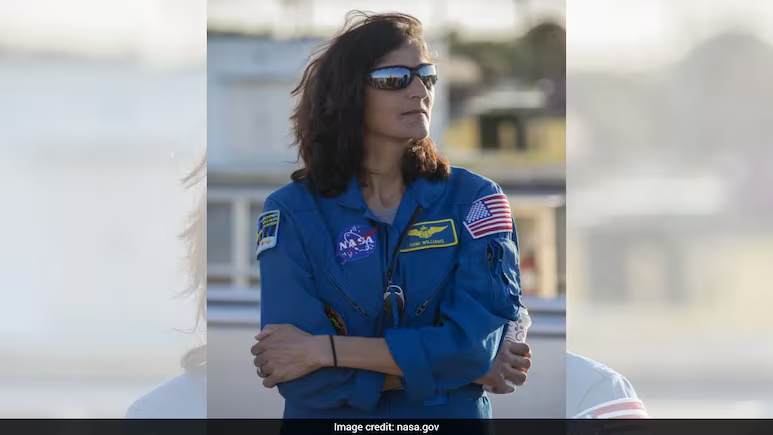
The retirement, announced by NASA on Tuesday, officially came into effect on December 27, 2025, just after Christmas.
NASA Honors a Trailblazer in Human Spaceflight
NASA paid glowing tribute to Williams, describing her as a pioneer who helped shape the future of human space exploration. Her leadership aboard the space station played a key role in advancing missions to low Earth orbit.
NASA Administrator Jared Isaacman said her work in science and technology laid the foundation for Artemis missions to the Moon and future exploration toward Mars, calling her career an inspiration for generations to come.
608 Days in Space: Records That Define Sunita Williams
Selected by NASA in 1998, Williams logged a total of 608 days in space across three missions, ranking second among NASA astronauts in cumulative time spent beyond Earth.


She also ranks sixth among American astronauts for longest single spaceflight, tied with Butch Wilmore, with both spending 286 days in orbit during NASA’s Boeing Starliner and SpaceX Crew-9 missions.
Williams completed nine spacewalks, totalling 62 hours and 6 minutes outside the station — the most by any female astronaut and fourth on NASA’s all-time list. She was also the first person to run a marathon in space, adding to her unique list of achievements.
Three Missions That Shaped Her NASA Career
Williams made her first journey to space on December 9, 2006, aboard Space Shuttle Discovery (STS-116). Serving as a flight engineer during Expedition 14/15, she set a then-world record with four spacewalks totalling 29 hours and 17 minutes.
Her second mission launched on July 14, 2012, from Kazakhstan’s Baikonur Cosmodrome as part of Expedition 32/33. During the 127-day mission, she conducted three spacewalks to repair an ammonia leak and replace a critical power system component on the station.
Her third and longest mission began in June 2024, when Williams and Butch Wilmore launched aboard the Starliner spacecraft for NASA’s Boeing Crew Flight Test mission. They later joined Expedition 71/72 and returned to Earth in March 2025.
Indian Roots and a Global Space Icon
Sunita Williams’ father was a neuroanatomist born in Jhulasan, Mehsana district of Gujarat, who later migrated to the United States and married Bonnie Pandya, a Slovenian.
Born in Euclid, Ohio, Williams considers Needham, Massachusetts, her hometown. Away from space, she enjoys an active life with her husband Michael, sharing interests that include working out, renovating houses, cars and aeroplanes, as well as hiking and camping.
Why Sunita Williams’ Legacy Will Endure
Reflecting on her career, Williams described space as her “absolute favourite place to be.” She called it an honour to have served in the Astronaut Office and credited her colleagues for making her 27-year journey at NASA possible.
She praised the International Space Station for its people, engineering, and science, saying it helped make future missions to the Moon and Mars achievable. As she steps away from active duty, Williams said she is excited to watch NASA and its partners take the next bold steps in space exploration and continue making history.