MERN stack is a collection of technologies that enables faster and more efficient application development. It is widely used by developers across the world to build modern, dynamic web applications. The primary goal of the MERN stack is to allow developers to create full-stack applications using JavaScript only.

Since all four technologies in the MERN stack are JavaScript-based, developers who understand JavaScript and JSON can easily manage the frontend, backend, and database layers of an application. This unified approach simplifies development and improves productivity.
What Is MERN Stack?
The MERN Stack is a combination of four technologies that work together to build dynamic websites and web applications. The term MERN is an acronym formed from the names of these technologies:
- M – MongoDB
- E – Express.js
- R – ReactJS
- N – Node.js
Together, these tools create a complete full-stack development environment powered entirely by JavaScript.
Once all four technologies are downloaded and configured, development begins by creating a new project folder. After opening the folder in the command prompt or terminal, the following command is used to initialize a project:
npm init
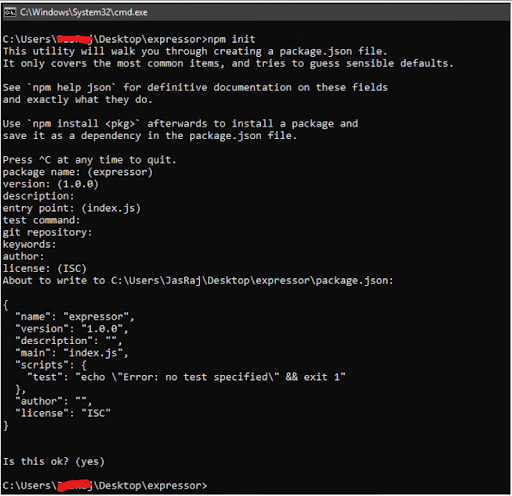
This command creates a package.json file, which manages project dependencies. Modules can then be installed using:
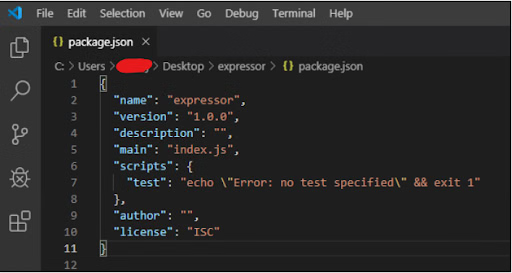
npm install module_name --save
MERN Stack Components Explained
The MERN stack consists of four core components, each responsible for a specific layer of application development.
1. MongoDB
MongoDB is a NoSQL database management system that stores data in the form of documents with key-value pairs, similar to JSON objects. It allows developers to create databases, schemas, and collections. MongoDB also provides a shell interface that enables querying, updating, and deleting records using JavaScript.
2. Express.js
Express.js is a backend web application framework built on top of Node.js. It simplifies backend development by reducing the need to write repetitive code. Express offers middleware support and tools for handling HTTP requests and responses efficiently.
3. ReactJS
ReactJS is a JavaScript library used to build user interfaces, especially for single-page applications and mobile apps. It allows developers to create reusable UI components and uses a virtual DOM to improve performance and rendering efficiency.
4. Node.js
Node.js is an open-source JavaScript runtime environment that enables developers to run JavaScript code outside the browser. It includes the Node Package Manager (npm), which provides access to thousands of reusable packages. Built on the Chrome JavaScript engine, Node.js is known for fast execution and scalability.
Why Should You Work With MERN Stack?
The MERN stack offers several advantages that make it a popular choice for developers.
One of its key strengths is the ability to create a three-tier architecture—frontend, backend, and database—using JavaScript and JSON throughout the application.
MongoDB, the database layer of the MERN stack, is designed to store JSON data natively. Its command-line interface and query language are also built using JavaScript, making it a natural fit with Node.js. This enables smooth manipulation, storage, and representation of data across all layers.
MongoDB also offers MongoDB Atlas, a cloud-based solution that simplifies database management by providing auto-scaling clusters on major cloud platforms.
Express.js streamlines server-side development by wrapping HTTP requests and responses, making URL routing simple and efficient. This works seamlessly with ReactJS, which focuses on building interactive and responsive user interfaces.
Since both frontend and backend communicate using JSON, data flows smoothly across the system. As a result, developers only need to master one programming language—JavaScript—along with JSON structures, making development faster and debugging easier.
MERN Stack Features and Techniques
The MERN stack also supports advanced features that enhance application performance and scalability.
1. MongoDB Aggregation
The aggregate() function in MongoDB enables advanced data processing using pipelines. It allows grouping, filtering, sorting, and projecting data, making it more powerful than basic queries.
2. Text Index
Text indexing improves full-text search performance in MongoDB. Instead of scanning each document word by word, it creates a lookup table of terms, enabling faster and more efficient searches.
3. Pagination
Pagination improves application performance by loading data in smaller chunks rather than all at once. This reduces server load and enhances user experience by displaying subsets of data along with navigation controls.
4. Higher-Order Components
Higher-Order Components (HOCs) in React enable code reusability by allowing shared logic across multiple components. They are commonly used for features such as authentication, logging, and UI elements like toast notifications.
Use Cases of MERN Stack
The MERN stack is suitable for a wide range of web applications, especially cloud-based projects that rely heavily on JSON data and dynamic interfaces.
1. Calendars and To-Do Applications
These beginner-friendly projects help developers understand core MERN concepts. React handles the UI, while MongoDB stores and manages tasks or events.
2. Interactive Forums
MERN is ideal for building forums or communication platforms where users can post messages and interact in real time.
3. Social Media Products
Beyond forums, MERN can be used to build social media features such as posts, advertisements, and embedded mini web applications.
MERN Stack Learning Roadmap
Learning the MERN stack involves a step-by-step approach that builds a strong foundation before advancing to complex concepts.
Step 1: Master the Foundation Languages
Begin with HTML, CSS, and JavaScript.
- HTML structures web pages and defines elements such as headings, tables, and images.
- CSS controls layout, styling, and responsiveness across devices.
- JavaScript adds interactivity, animations, and dynamic behavior to web pages.
Step 2: Gain Programming Experience
Practical experience with development tools is essential. Important tools include:
- Git for version control
- Visual Studio Code for code editing and debugging
- Bootstrap for responsive design
- Sass for advanced CSS styling
Step 3: Understand Website Design
This step focuses on layout planning, color schemes, typography, alignment, and overall usability. A well-designed website should be engaging, visually appealing, and easy to navigate.
Step 4: Become Proficient in MERN Technologies
Once the basics are clear, start learning MongoDB, Express.js, React, and Node.js in detail. Each technology plays a critical role in full-stack development and must be practiced thoroughly.
Step 5: Enhance Your Skills
Skill improvement comes through practice. Work on projects of increasing complexity, apply for internships, and gain real-world experience to strengthen your expertise.
Career Path and Job Growth for MERN Stack Developers
With increasing investments in web and app development, MERN stack developers have strong career prospects. Common career roles include:
- Junior MERN Stack Developer
- Full-Stack Developer
- Full-Stack Architect
- Backend Node.js Developer
- Frontend React Developer
- Technical Lead
- Senior MERN Stack Developer
Each role involves different responsibilities, ranging from development and maintenance to system architecture and team leadership.
Best Certifications for Aspiring MERN Stack Developers
Several certifications can help validate MERN stack skills:
- Full Stack Developer – MERN Stack Master’s Program
- Microsoft Azure Developer Associate (AZ-204)
- Fundamentals of MERN Stack (SkillUp Program)
These programs provide structured learning and industry-relevant knowledge.
Conclusion
The MERN stack provides a powerful and flexible solution for full-stack web development. By enabling JavaScript across the entire development process, it simplifies project management and accelerates application delivery. With MongoDB, Express.js, React, and Node.js working together, developers can build high-performance, scalable applications efficiently.
For developers aiming to grow their careers in 2026, mastering the MERN stack remains a valuable and future-ready skill.